AUTHOR PROVENANCE STATEMENT: The following text describing my journey to AI expertise was touch-typed in Apple Notes on my computer, starting on the morning of October 22, 2025 (first published Nov 10, 2025). AI was not used to generate any section or sentence of the following text. Proof of provenance is available upon request.
Welcome to my updated website. I’ve owned this domain, GabrielCassady.com, for around a decade and, until recently, that’s really all it was—a URL I owned.
In 2022 I had my first conversation with ChatGPT. In those days, ChatGPT was powered by the nascent GPT-3.5, and it was still more fluent and natural than any other machine conversation I had ever had, up to that point.
Keep in mind, I’m on the older end of the millennial generation, nearing 40 years old. I remember using landlines and dial-up. My experience with computer technology starts with DOS commands and dying of dysentery on a black and green Oregon Trail. I remember sitting on my uncle’s lap and tinkering with novelty software such as a literal stochastic parrot that mostly squawked random nonsense while occasionally recording and parroting something you said back to you.
But that first conversation with ChatGPT was Earth shattering to me.
It was impressive, on its face, even at that time. But I knew what it likely meant for our near future because information technology (IT) is never truly static or “finished”. Rather, It’s a dynamic and ever-evolving force. The technology we wield in this decade is a result, in part, of the technology we mastered in the previous decade.
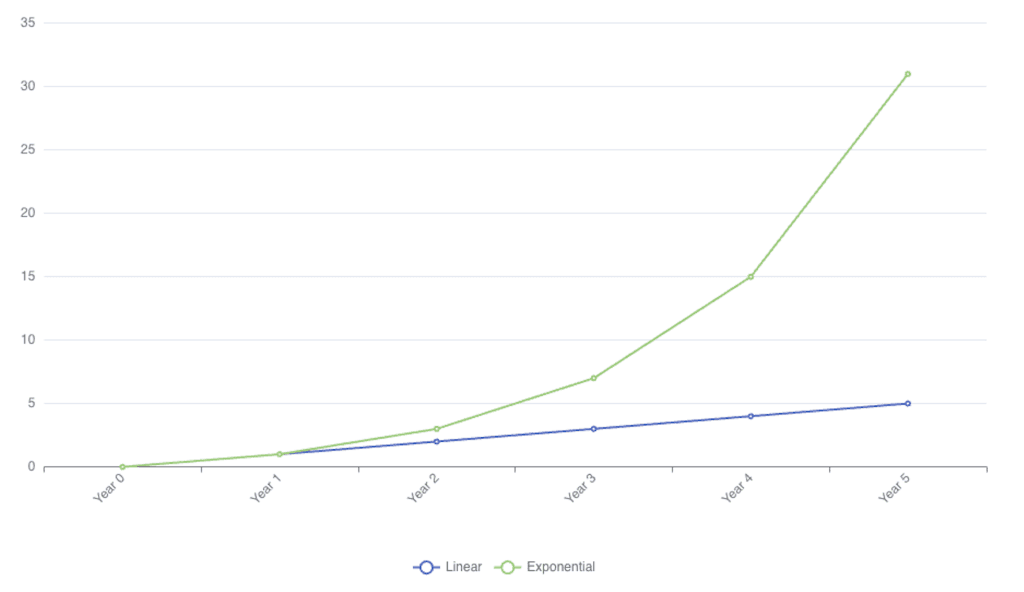
I.T. research and development is subject to what futurists and AI experts call “The Law of Accelerating Returns”, which means the more information technology we discover, the faster we can discover more information technology. Proposed by Ray Kurzweil, The Law of Accelerating Returns suggests that the rate of change in various evolutionary systems, including technological progress, tends to increase exponentially rather than linearly (see example graph, below).
From the moment after I first engaged with ChatGPT in 2022, I committed myself to an aggressive regimen of AI-focused education and “upskilling”. I wanted to learn as much as possible—as fast as possible—about this tech innovation, which has come to be known as generative AI because the algorithms actually generate novel outputs.
In other words, I was determined to become an AI expert, come hell or high water!
The first thing I learned was generative AI does not compute its outputs in the deterministic way we are used to seeing with programmed computers. These new machines operate by, essentially, layering complex statistical operations on top of complex statistical operations. Surprising even their creators, such layering of statistical complexity allows generative AI to generalize or infer new outputs from the vast amounts of data on which they are “trained”.
Over the last 3 years or so, I’ve read countless books (see my reading list here), ingested an endless stream of audio and video, and otherwise spent anywhere from one to eight hours of every day tinkering with, building around, or reading and presenting on generative AI.
I was beyond enthusiastic—I became obsessed with understanding this technological innovation.
But Why Would I Even Care in the First Place?
My wife, Kylie, and I had started a full-service marketing, public relations, and advertising agency in 2017 called 2oddballs, which has since enjoyed considerable success—even surviving the COVID pandemic and its attendant economic disruptions. Upon having that first, pivotal ChatGPT conversation, I immediately realized my ability to wield this new tool would be critical, if I wanted 2oddballs to survive into the future.
Kylie and I have always had different roles in 2oddballs. Though we’re both tech-savvy millennials, I was always the closest thing we had to a programmer or developer, despite my education being in Public Relations (minor in Journalism, Missouri State University, 2012).
My lifelong passion for—and experience with—information technology was given a boost by several tech-related courses in college, including a website design and construction course and others, all of which strengthened my technical understanding of computer hardware and software. I learned the basics of HTML and CSS, and I learned how to use Photoshop and a few other design tools.
Meager as it may have been, that foundation of IT knowledge and experience became my launchpad into the world of AI and AI expertise.
So, in 2022, I took-off on this wild AI adventure. By 2023, I was already feeling confident in my choice of direction. On top of my professional progress, my personal life seemed to be moving forward, as well. 2023 was going to be the year Kylie and I started our family, together. We were married in 2019, bought a house a few years later, and we were ready to put down even deeper roots.
Unfortunately, in July of 2023, doctors discovered a wildly rare and deadly cancer called embryonal rhabdomyosarcoma, and much of my life had to be put on hold.
Despite my expectations, I believe the cancer actually accelerated my journey along the AI learning curve because I had more downtime to think, read, and tinker than I otherwise would have as a busy small business owner.
By the time I was declared cancer-free in mid-2024, I was convinced the technology behind generative AI tools like ChatGPT were going to precipitate a transformation of human society on par with electricity and the atom bomb—combined.
The timing, ferocity, and the ultimate outcome of such a radical transformation is up for debate, but I believe we humans, as a species, do have some level of control over the admittedly uncertain AI future. I aim to maximize the chances of that outcome being positive for humanity.
My goals are ultimately selfish in that, in 2022, I saw something coming that was a direct threat to the lifestyle and business I was enjoying at the time, which wasn’t wealthy or particularly impoverished, but it was comfortable enough.
I believed—and still believe—that radical change is upon us. Ever since that moment in 2022, I have been trying my best to act in accord with that belief.
You might say I made a bet, of sorts. In 2022, that bet was made with my time, talent, and treasure—I made a forecast based on the murky and uncertain vision of change described above.
As of 2025, that forecast has largely been proven accurate. In other words, I won that bet, and it’s time to cash-in my winnings.
Ironically, I’m not the kind of person who is heavily motivated by the promise of ever-increasing sums of money and wealth. I realize that’s a privileged attitude, but I think it’s an important fact for you, dear reader, to understand. I am a socially motivated person, so I naturally seek novelty and prestige over monetary wealth.
That may sound shallow, but it’s how my brain works. I want to learn more, learn new, and learn useful facts about the world and share them with others. I’ve always been that way, as long as I can remember.
Luckily, as a mature adult who has seen some shit in his short few years, I’m also compassionate and kind-spirited. I’ve walked in many different kinds of shoes. I’ve lived and worked in three different countries, including Ecuador, Taiwan, and my nation of origin, the good ol’ U.S of A. I have more than I need in life as I’ve been blessed by the love and caring of many friends and family members. Additionally, I’ve been graced with good fortune beyond even my own formidable imagination.
For all the above reasons and more—I want to give back to a world that, on balance, has treated me with a surprising amount of grace and mercy.
What Am I Doing With All This AI Stuff, Anyway?
I have two answers:
- I want to contribute positively to humanity by offering my knowledge, skills, talents, and passions to anyone brave enough to stand beside me and the rest of humanity as we step forward into the uncertain AI future.
- As is required in a capitalist economy—I need to make money to contribute to my household and to my community as a responsible, productive citizen. We can litigate the merits of capitalism all day, but we would still be arguing about it while living in it. We can only operate from where we exist, and I exist in the United States of America—let’s figure this out together, please.
So, to answer the titular question, “What Kind of AI Expert Am I (Gabriel Cassady), Exactly?” In a sentence: I’m a communication expert specialized in Information Technology (I.T).
Until recently, that expertise extended only as far as human communication because my education and experience has largely revolved around the use of language and other human-centered communication tools and tactics, including visual and auditory communication, more broadly.
My experience with and enthusiasm for information technology has primarily evolved as yet another set of tools in the human communication toolbox, and I thought that’s how it would remain for the rest of my career. I thought, unless cats and dogs suddenly gleaned the ability to use words and the internet, the scope of my life’s work would always be bounded by the communication capabilities and tools—digital or otherwise—of humanity.
That was, until that first chat with a generative AI tool in 2022, when everything changed.
Today, my AI expertise is some mix of AI integration and automation specialist, AI-science communicator, prompt engineer, and web developer/web systems admin. When it comes to AI, my general knowledge of the field is broad, with technical depth in the areas of generative AI model optimization, customization, fine-tuning, and integration. I don’t build generative AI models from scratch, but everything else you might want to do with an existing “frontier” AI model after it’s been released—that’s where I come in as an AI expert.
For a communication professional, I have a surprisingly strong technical mastery of things like web development, Application Programming Interfaces (APIs) and integrations, data serialization, and of course, working with AI platforms themselves.
That said, if I’m being brutally honest with myself, what I really love is researching, talking about, debating, and writing on the topic of AI. I find it endlessly fascinating and even somewhat mysterious—even AI Experts who do create these machines cannot fully interpret what’s going on inside of them.
Do I still enjoy deep work projects that require hours of focused solitude, staring at a computer screen—absolutely. I can “hyperfixate” (i.e. a symptom of my ADHD) with the best of ‘em (hence this tome you’re reading now). But I prefer learning, sharing, and problem solving with (and for) others.
So, as an AI Expert, what can I get AI to do for YOU?
A great question—unfortunately, it’s not easy to answer that question without knowing at least a little about who YOU are. The main challenge in answering that question directly is the general nature of this technology—It’s like asking, “what can an electrician get electricity to do for me?” The simplest answer is “a lot!”
If you’re ready to find out what my AI expertise can do for you, right now, then fill out the form on my contact page or shoot me a call, text or email, and I’ll send you some ideas that are specific to the work you do.
Here’s one thing I can promise you: the sooner you reach out, the better the deal you’re likely to get. Demand for the knowledge and skills I’ve been cultivating is only growing, and my calendar is filling up fast.
I look forward to hearing from you!