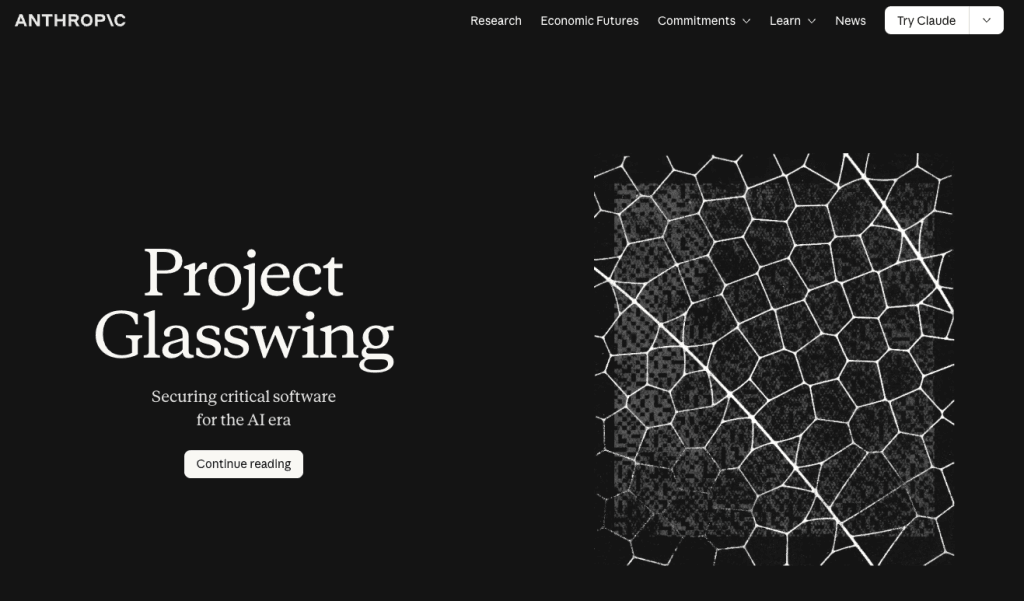
Anthropic just made one of the most important AI announcements of the year, and the most telling part is what it didn’t do: it did not release its newest model to the general public. Instead, it launched Project Glasswing, a restricted cybersecurity effort built around Claude Mythos Preview. Anthropic says the model has already identified thousands of previously unknown vulnerabilities, including serious flaws in every major operating system and every major web browser.
That is the real story here.
This post is not really about product branding or whether “Project Glasswing” or “Claude Mythos” are clever names. It’s about the signal Anthropic is sending: frontier AI capability appears to have taken another sharp step upward, especially in coding, reasoning, and offensive-defensive cyber work. When a company decides its strongest model is too risky for normal release, business leaders should pay attention.
Why this feels different
We have all gotten used to a certain rhythm in AI: new model, benchmark chart, demo clips, API rollout, and then a lot of hot takes on social media. This announcement breaks that pattern. Anthropic says Claude Mythos Preview can surpass all but the most skilled humans at finding and exploiting software vulnerabilities, and that it found bugs that survived years or even decades of human review and automated testing.
A few examples from Anthropic’s own materials are hard to ignore:
- a 27-year-old OpenBSD vulnerability,
- a 16-year-old FFmpeg bug in code that automated tools had exercised millions of times, and
- a Linux kernel exploit chain that escalated ordinary access to full machine control.
If those claims hold up under broader scrutiny, this is not just “a better chatbot.” It is a meaningful jump in what these systems can do in the real world.
Anthropic’s caution makes sense. I still hate it.
My reaction is mixed.
On one hand, I understand why Anthropic is being careful. Their stated position is that Mythos-class capabilities could make cyberattacks more frequent and more destructive if released without adequate safeguards. That is not crazy. In fact, given what they are claiming, restraint would be the responsible move.
On the other hand, I’d be lying if I said I wasn’t disappointed. Part of what makes this era of AI so interesting is the ability to personally test the new thing, poke at the edges, and see what changed. This time, most of us do not get to do that. And that absence is itself revealing. If a frontier lab is saying, “Not this one. Not yet,” that is a headline.
What Project Glasswing actually is
Project Glasswing is Anthropic’s coordinated cybersecurity program with partners including AWS, Apple, Broadcom, Cisco, CrowdStrike, Google, JPMorganChase, the Linux Foundation, Microsoft, NVIDIA, and Palo Alto Networks. Anthropic says the group will use Mythos Preview to find and fix vulnerabilities across critical software and infrastructure. The company also says it is committing up to $100 million in usage credits and $4 million in donations to open-source security efforts.
In plain English: they are trying to help defenders patch the world before comparable capabilities spread more broadly.
That should get every executive’s attention, even if you never plan to touch Claude directly.
What this means for business owners and executives
1. Your patching window is getting uglier
If AI systems can discover and weaponize vulnerabilities faster, the old comfortable assumptions around patch cycles start to break down. Anthropic’s partners are describing a world where defenders and attackers both move faster, and where delay becomes more expensive.
If you run a business, this is not just an IT department issue. It is operational risk, legal risk, vendor risk, and reputation risk rolled into one.
2. “We’ll deal with AI later” is getting harder to defend
Even if your company is not building with frontier models, your software vendors are. Your cloud providers are. Your security tools are. Your attackers probably will be too. Anthropic’s own framing is that this capability jump changes the urgency of securing critical systems now, not someday.
3. Defensive AI is becoming table stakes
The long-term implication here is not merely that AI can attack. It is that organizations may need AI-assisted defense just to keep up. Anthropic explicitly frames Glasswing as an effort to give defenders an advantage before these capabilities proliferate more widely.
4. The biggest signal may be strategic, not technical
Executives do not need to memorize benchmark names to understand the core message. Anthropic published benchmark gains over Opus 4.6 across coding, cyber, and reasoning tasks, including CyberGym, SWE-bench Verified, Terminal-Bench, GPQA Diamond, and Humanity’s Last Exam. The exact scores matter less than the pattern: this appears to be a broad capability jump, not a one-trick pony.
So, is this hype?
Maybe some of the public reaction will be. That always happens. And to be fair, all of this is coming from Anthropic’s own announcement and technical write-up, so some healthy skepticism is appropriate.
But skepticism should cut both ways.
The lazy skeptical take is, “AI companies always say the next model is amazing.” The stronger skeptical take is, “Why would a company forgo the obvious marketing win of a broad release unless it believed the risk case was real enough to justify the cost?” That doesn’t prove every implication people are drawing online. It does suggest this is not business as usual.
What I’d do if I were running a company right now
- Shorten the distance between patch release and patch deployment. If your organization still treats updates like a leisurely quarterly ritual, that posture may age badly.
- Ask your security team what changes if AI-assisted vulnerability discovery accelerates. Not in theory. In your actual environment.
- Review your critical vendors. Find out which ones have credible AI-era security practices and which ones are still speaking in generic compliance fluff.
- Expect more from leadership, not just IT. If this trend continues, cyber readiness becomes a board-level and owner-level question.
- Stay curious without getting gullible. We do not need panic. We do need to notice when the ground shifts.
The bigger takeaway
I think Anthropic is probably right to be cautious here.
I also think the fact that they need to be cautious is the bigger news.
Claude Mythos may or may not end up being remembered as the turning point. But Project Glasswing sure looks like one of those moments when the people closest to the frontier are quietly telling the rest of us, “The world just got weirder. You should probably update your assumptions.”
And if you are a business owner or executive, that is your cue.
Subscribe to my email newsletter using the form at the bottom of this page if you want more plain-English updates on AI shifts like this one. If you’re ready for more direct guidance tailored to your organization’s needs, contact me here.