AI reputation damage means that even if your company looks fine in Google’s normal search results, that does not mean you’re safe in AI-powered search results — whether that means an AI summary from Google or a chat response from ChatGPT.
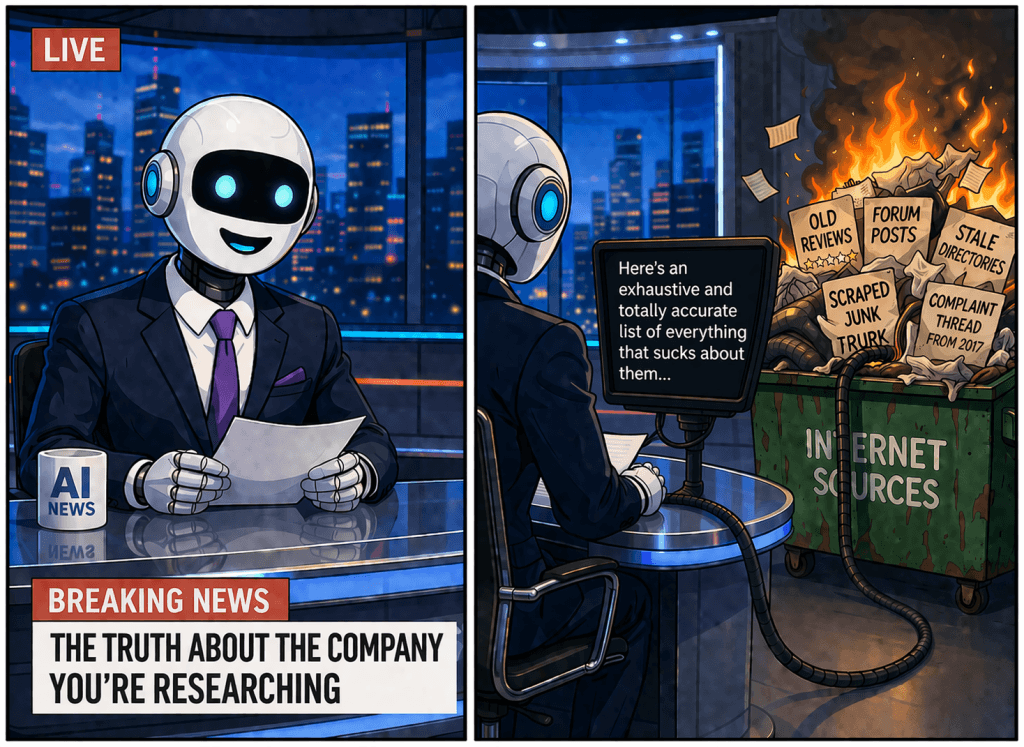
That is the uncomfortable part. A business can have a decent website, solid reviews, and years of honest work behind it, yet still get summarized badly by an AI system that pulls from stale articles, complaint threads, scraped directories, forum chatter, or old claims that got repeated often enough to stick.
In plain English: AI search can turn old noise into a fresh credibility problem.
The real risk is not just “hallucinations”
Yes, frontier models can make stuff up (i.e. “hallucinate”). Even the companies building them say so. Anthropic explicitly warns that models can produce incorrect or misleading responses, and OpenAI says hallucinations remain a stubborn problem rather than a solved one.
But for brands, the bigger problem may be something messier than a pure hallucination: AI can confidently remix half-true, outdated, or low-quality information into a neat-looking answer. That’s AI reputation damage in a nutshell.
That matters because many users treat the polished summary as the answer, not as the start of an investigation. Search Engine Land recently put it bluntly: in AI search, the most accurate claim does not necessarily win; the most repeated claim often does.
Why this should worry business owners
If you run a company, nonprofit, practice, or public-facing organization, you likely already know how hard it is to manage reputation in the ordinary internet. Now add systems that compress many sources into one authoritative-sounding paragraph.
That paragraph may mention an old lawsuit with no resolution context, a location you closed years ago, a pricing rumor, a bad review trend from a rough season, or a flatly wrong description of what your business does. Search Engine Land has also noted that AI-driven search can misrepresent brands when models synthesize incomplete or inaccurate source material.
This is not just a marketing nuisance. It can affect trust, sales conversations, recruiting, partnerships, and investor confidence.
One reason this problem is dangerous is that AI systems are good at sounding organized, neutral, and sure of themselves. Gabriel’s own writing often comes back to the same core idea: people confuse polished communication with truth, and trust is fragile once broken.
That is exactly the trap here. A clean summary is not the same thing as a reliable one.
So, what can you actually do about AI reputation damage?
Unfortunately, no one has a silver bullet. Anyone selling one should probably make you nervous.
What you can do is reduce chaos and improve your odds:
- Audit your brand in AI systems regularly. Test the obvious prompts: your company name, your founder’s name, “Is [brand] trustworthy?”, “What are complaints about [brand]?”, “Who are [brand] competitors?”
- Document false or outdated claims. Save screenshots, dates, prompts, and outputs. Treat this like reputation incident tracking, not casual browsing.
- Strengthen your official source footprint. Make sure your website, About page, leadership bios, contact data, policies, FAQs, and business profiles are current and consistent.
- Publish clarifying material where confusion exists. If there is an old controversy, a common misconception, or a frequent false claim, address it clearly and calmly on channels you control.
- Improve off-site consistency. Directory listings, press coverage, partner pages, association profiles, and major social profiles should not contradict each other.
- Escalate genuine defamation or platform violations. Sometimes the issue is not “AI being weird.” Sometimes it is bad source material, impersonation, or malicious content that needs formal review.
- Train your team not to trust AI summaries blindly. Sales, support, recruiting, and leadership teams should verify high-stakes claims before reacting to them.
What NOT to do
- Do not assume one corrected webpage fixes the issue overnight.
- Do not panic and start publishing defensive junk content everywhere.
- Do not let an agency bury you in jargon while promising certainty they cannot possibly deliver.
Business is hard enough without chasing every shiny new acronym. If someone claims they can fully control how every AI system describes your brand, be skeptical.
The bigger lesson for everyone using AI
This is also a user problem, not just a brand problem. AI users should treat high-stakes answers with caution and verify them manually. Anthropic recommends reviewing cited sources and not relying on the model as a singular source of truth.
That is good advice for executives too. If an AI says something alarming about a company, a person, or a nonprofit, slow down. Check the source material. Check dates. Check whether the claim is current, contextualized, or even real.
No easy answers. But ignoring it is worse.
The internet is changing faster than most organizations can adapt. That alone would be enough to justify concern. Add AI synthesis on top, and reputation management becomes less about “ranking well” and more about whether the machine’s compressed story about you is fair, current, and grounded in reality.
If AI is already muddying the waters around your brand, don’t wait for it to sort itself out. It may not.
Contact me if you want help assessing the problem, documenting what AI systems are saying, and building a practical response plan. I do not have magic beans. But I do believe a calm, evidence-first strategy beats denial every time.