The idea for (and initial draft of) the following article on data center sites in Missouri was touch-typed by me, Gabriel Cassady, in Springfield, Missouri on May 19, 2026. AI was used as a research assistant (sources linked throughout) and editing assistant, but the words, opinions, and bad jokes are mine.
If you flew in from out of state and started poking around Missouri thinking that — because this area leans red — you’d have an easier go of trying to site a data center here, I have some unsolicited advice for you.
Go buy a coffee at a locally owned shop, sit down, and listen for about forty-five minutes before you start talking.
Because what a lot of folks from the coasts don’t seem to understand about Missouri, Arkansas, Oklahoma, Kansas, and the rest of the so-called “flyover” states is that this area isn’t just conservative and Christian (though, it is certainly those things, as well). There’s also a strong libertarian streak running through these hills that distrusts large, unfamiliar bureaucracies.
All of them. Including corporate ones.
Practically, Missourians want to be left alone, and they don’t appreciate folks from elsewhere telling them what to do — even if “elsewhere” is a different part of Missouri, itself.
Politically, Missourians are more diverse than you might at first suspect. It wasn’t that long ago we had a Democratic governor.
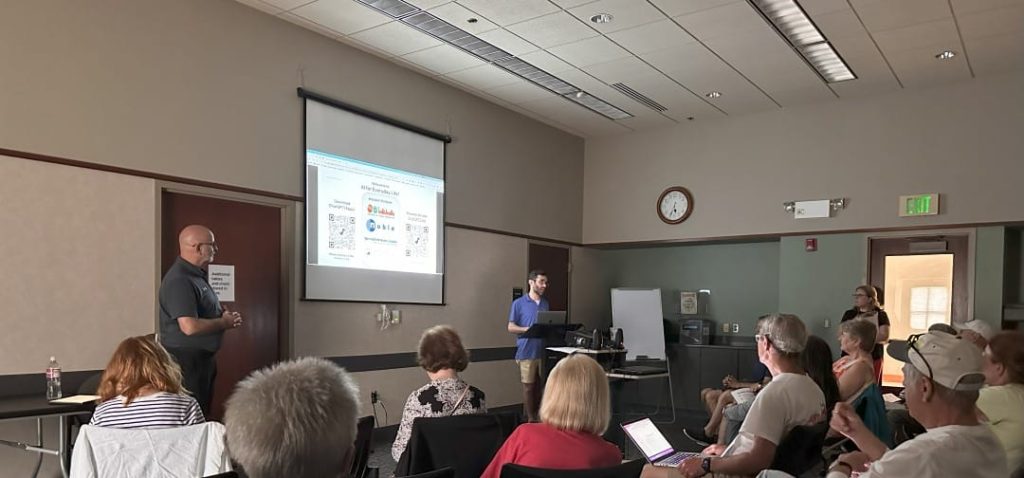
These days, you can see the middle-finger-to-the-man streak alive and well in our cannabis laws. And you can see it right now, (almost) in real time, at a high school auditorium in Marshfield, Webster County, Missouri, where, on May 11 of this year (2026), hundreds my neighbors showed up to demand a one-year moratorium on a data center being built on — wait for it — Rifle Range Road.
That may have been the most “Missouri” paragraph I’ve ever written. I digress.
That meeting was covered, ably, by Karen Craigo at the Springfield Business Journal. I’d recommend reading her reporting on the May 11 meeting and her follow-up on the second data center now eyeing Marshfield before you do anything else.
So, is it impossible to find data center sites in Missouri? No.
Is it as simple as “land + tax incentive + a friendly handshake at the Chamber of Commerce”? Also no. Not anymore. Not in 2026.
You may have a harder time getting reliable power than getting public support, if you play your cards right. But you have to actually have cards, and you have to actually play them. Most of the out-of-state operators showing up in the Ozarks right now appear to be doing neither.
What follows is a working consultant’s read on what’s actually going on at the crossroads of AI infrastructure, Missouri politics, and southwest Missouri specifically. I am not an attorney, an electrical engineer, or a utility planner. I am, however, a Springfield-based AI consultant and — along with my wife, Kylie — the co-owner of 2oddballs Creative, which is a full-service marketing, PR, and advertising agency that has spent over eight years figuring out how to talk to Missourians on behalf of people from somewhere else.
Consider this the field guide I’d give a friend who called me from a hotel room in Kansas City asking what the hell just happened to their site plan.
First lesson: Kansas City is mostly in Missouri (And, for now at least, the Kansas City Chiefs is a Missouri football team).
The cultural read most out-of-state developers get wrong
Missouri communities are not automatically anti-corporate, and they are not automatically anti-data-center. We’re not Oregon. We’re not Vermont. Missourians, broadly speaking, like jobs, we like investment, and we like the idea that the Ozarks are part of the future of American industry, not just its past.
What Missourians don’t like — and this part is bipartisan, suburban, rural, urban, every demographic you can name — is feeling like the deal got cut over their heads.
The current Webster County situation is a near-perfect case study. Lumon Solutions LLC is aiming to build a data center in Missouri on Rifle Range Road in Webster County and, by the developers’ own description, it’s a small-scale facility: 5 acres, closed-loop cooling, a residential-style well rated at about 20 gallons per minute, and an estimated 12-15 jobs. That’s not a hyperscale build. That’s a modest facility. As the Springfield Business Journal reported, Webster County’s own Presiding Commissioner Paul Ipock told residents he doesn’t believe it’s “a big 400-pound gorilla that people are afraid of.”
He may well be right. But the meeting still went sideways.
Why? Because:
- Webster County voted down planning and zoning three times, most recently in 2007 — meaning the county cannot impose ordinary land-use conditions on an unincorporated-area project, even if it wanted to.
- The county commission, by its own admission, didn’t know the project was coming until it was well underway.
- The developer is bound by NDAs and won’t name the end client.
- A second data center, Texas-based Swarm Systems Inc., has been quietly talking to the city of Marshfield since November of 2025 — talks that residents are only now learning about based on emails obtained from the city.
Whether or not any of that adds up to a genuine environmental or economic risk, it absolutely adds up to a procedural betrayal in the minds of locals. People feel surprised, condescended to, and locked out of a decision that they feel will reshape their water table, their power grid, their property values, and their kids’ commute home from after school activities.
That feeling is the actual variable a smart site selector should be taking into account.
Missouri’s specific mix of weak county-level zoning, strong municipal independence, and a deeply ingrained “we vote the people who told us about it” political culture means that the cost of comms failure is unusually high for anyone trying to secure data center sites in Missouri.
If you take nothing else from this article, take this: in 2026, community legitimacy is a site constraint, not a PR exercise. If you’re trying to find data center sites in Missouri, it belongs on your due-diligence checklist next to substation capacity and water rights. Treat it as anything less and you will lose months, millions, or both.
OK. Now the practical stuff.
Power (not land) is the first real gate on data center sites in Missouri
I know “land is cheap in the Midwest” is in every site selector’s slide deck. Forget it for a minute. For anyone looking to secure data center sites in Missouri in 2026, the gating issue is power.
In April of 2025, the Missouri legislature passed Senate Bill 4, which among other things, directed the Missouri Public Service Commission (PSC) to develop large-load rate structures that ensure other classes of customers don’t end up subsidizing data center electric demand. The PSC did exactly that. As of late November 2025, both Ameren Missouri and Evergy Missouri Metro / Evergy Missouri West have approved large-load tariffs that apply to customers expecting 75 megawatts or more of monthly peak demand.
What that tariff requires, in plain English:
- A minimum 12-year contract, with an option to extend.
- The large-load customer covers full electric and infrastructure costs — meaning if data center sites in Missouri force a substation upgrade or transmission build, that’s on them.
- Collateral equal to two years of minimum monthly bills, in case you go bankrupt or pack up and leave.
- Annual compliance reporting to the PSC.
This is not the language of a state that’s afraid you won’t come. It is the language of a state that has watched what’s been happening in Virginia and is making sure the bill doesn’t land on a retired schoolteacher in Sedalia.
A few important wrinkles for southwest Missouri specifically.
Liberty Utilities (Empire) is the dominant investor-owned utility in the Joplin–Branson corridor. Liberty’s Missouri large-load process defines a “large-load customer” as a new or existing customer with 10 MW or larger demand at a single transmission interconnection point — not 75 MW. That’s a much lower trigger. And Liberty is currently building approximately 90 miles of new 345 kV transmission line and upgrading the Ozark-to-Branson line from 69 kV to 161 kV. Translation: Liberty is investing real money to make southwest Missouri capable of serving larger loads. They are also paying close attention to who shows up asking.
City Utilities of Springfield is a municipal utility, not investor-owned, so the PSC large-load tariff doesn’t apply to it in the same way. CU reports that 34% of its delivered energy in 2024 came from renewable sources — that is meaningfully above the statewide Missouri average. CU also has 150 MW of hydrogen-capable natural gas turbines and 36 MW of battery storage on the way, plus an active Regional Water Supply Taskforce. If your data center story needs to be a “clean energy” story, Springfield is the most defensible place in southwest Missouri to tell it. Just be precise about what “clean” means: utility mix, RECs, PPAs, dedicated on-site renewables, or some combination. Don’t bluff it. People here will look it up.
Cooperatives, which serve much of rural southwest Missouri, operate under yet another regulatory framework. PSC jurisdiction over cooperatives is limited. That means the actual gating questions in cooperative territory are usually about substation capacity, transmission queue position, and whether your project pencils for the co-op’s existing members. When researching data center sites in Missouri, don’t assume because there’s a substation visible from the parcel that there’s deliverable headroom in it: Ask — In writing.
Beyond Missouri itself, the SPP (Southwest Power Pool), which covers most of southwest Missouri, has a relatively new High Impact Large Load (HILL) framework explicitly aimed at data center sites in Missouri and other very large new loads. SPP is trying to be competitive on speed and certainty, but their own materials make clear that the traditional interconnection process was not built for what’s coming. The fact that they had to write a new framework tells you everything you need to know about how the queue used to work.
The U.S. Department of Energy estimated in December of 2024 that U.S. data centers consumed about 4.4% of all U.S. electricity in 2023 and could hit somewhere between 6.7% and 12% by 2028. That’s not a gentle bump. That’s a step change, which at present, is being absorbed by a grid that was not designed for it.
The honest read: if you’re looking for data center sites in Missouri and your project needs more than about 75 MW in Ameren or Evergy territory, or more than about 10 MW in Liberty territory, start the utility conversation before you start the real estate conversation. Not after. Not in parallel. Before.
Water in Missouri is looser on paper, tighter in practice
Out-of-state developers often start searching for data center sites in Missouri assuming water is going to be the hard part because that’s the story everywhere else. They’re only half right.
Missouri operates under riparian “reasonable use” doctrine. The state does not set a general numeric allocation system the way many western states do. Per the Missouri Department of Natural Resources, DNR does not regulate data center sites in Missouri specifically, does not have a formal data center definition, and often doesn’t even learn about a project until permit applications cross its desk.
So on paper: looser than you might expect.
In practice: tighter than you want it to be.
A few things to know.
First, Missouri does require major water users to register and report annually. A major water user is defined as a facility with the ability to withdraw 100,000 gallons per day, or 70 gallons per minute, or more. That threshold is low enough that any non-trivial closed-loop cooling system, evaporative cooling tower, or process water draw is going to put you in major water user territory.
Second, the U.S. EPA released updated 2026 guidance for data centers that explicitly emphasizes early utility engagement, transparent water use metrics, closed-loop or less water-intensive cooling, Water Use Effectiveness (WUE) reporting, reclaimed water where feasible, and — critically — direct funding contributions from developers to utility upgrades when their demand will stress the local system. That guidance has no enforcement teeth on its own. But, if your goal is securing data center sites in Missouri, it is now the baseline professional standard against which your project will be evaluated by reporters, activists, and regulators.
Third, and this is the one that will matter most to anyone researching data center sites in Missouri, especially in southwest Missouri: the same nameplate water draw means radically different things in different local utility contexts. A 200,000-gallon-per-day cooling load is a rounding error on Springfield’s system. The same load would consume a noticeable chunk of Marshfield’s daily output. The City of Marshfield’s public water system operates three deep wells with about 1,000,000 gallons of elevated storage and serves an equivalent residential population of roughly 7,425. That’s not “small town with a water tower” — that’s a real utility with real capacity. But it’s not Springfield. Pretending otherwise is how you get a packed high school auditorium.
The defensible move: design your water story before you select your site. Closed-loop. Reclaimed where available. Documented WUE numbers you’d be willing to publish on the front page of the local paper. Direct contributions to utility infrastructure where your demand creates measurable stress. Then bring that story to the community before the rumor mill brings its own version of your story to you.
City limits versus unincorporated county — same county, completely different game
This is one of the most important things I can tell you about securing data center sites in Missouri, and almost nobody outside the state seems to understand it.
Webster County, where the current Marshfield-area controversy is unfolding, is a third-class Missouri county. Per state statute, third-class counties have an assessed valuation under $450 million and have only limited authority to pass ordinances. Webster County also has no planning and zoning commission — most recently, voters rejected one in 2007. Commissioner Dale Fraker told residents on May 11 that the commission can’t legally stop a junkyard, a commercial slaughterhouse, or — and this is a direct quote — “a nuclear power plant” inside the unincorporated county.
So, what happens if your parcel is unincorporated Webster County? Practically speaking, very little can be done at the county level to stop you, or to formally bless what you’re doing. That sounds like a green light. It is not. It is a yellow light flashing at high speed.
Because here’s the thing — when the county can’t act, the politics don’t disappear. They escalate. They go to Jefferson City. They go to the press. They go to the state’s environmental and economic development agencies. They go, increasingly, to nonprofit legal organizations who specialize in raising hell for anyone looking to secretly install data center sites in Missouri. Right now, in Marshfield, a group of residents has already retained outside counsel and circulated a draft moratorium for the commission’s signature. That’s not theoretical. That happened the week of May 11.
Inside city limits, however, the picture is completely different.
The City of Marshfield’s Board of Aldermen passed two ordinances on April 23 of this year. The first defines a data center in city code. The second classifies data centers as a conditional use within heavy industrial zoning districts. That means a future data center inside Marshfield city limits must go through the city’s Planning & Zoning Commission, get approved by the Board of Aldermen, and pass a public hearing process — and the city can impose conditions: sound barriers, renewable power percentages, on-site wells, road paving, lighting restrictions, anything within the broad police-power umbrella that reasonably relates to mitigating impact.
Same county. Same map. Two completely different stories on data center sites in Missouri within a four-mile radius.
The Lumon Solutions facility on Rifle Range Road is unincorporated. The Swarm Systems site that just came to light — 8.2 acres of the 630 George Street parcel in the city’s industrial park — is inside Marshfield city limits. Which means Swarm Systems will go through a public process whether they want to or not. Lumon Solutions did not, and now everyone in town is mad about it.
If you are a site selector looking for data center sites in Missouri, this should reframe your map. Inside city limits is not slower. Inside city limits is faster, in the only sense that actually matters. Outside city limits looks fast right up until the moment it isn’t, and by then the local paper has a Facebook group with twelve hundred members and a public records request in your inbox.
This pattern repeats across Missouri. Joplin annexed and rezoned the 600-acre data center parcel only after hours of public testimony. Independence approved billions in tax breaks for the Nebius campus — about 400 acres, 2.5 million square feet, 800-plus MW — after sustained public opposition. Festus is now talking with a $6 billion developer after St. Charles imposed a one-year moratorium on data center development in August of 2025. Jefferson County has gone far enough into this that it now maintains an official data center information page with committee materials, health guidance, and legislation links.
In every case, the cities and counties that ran a clear process — even a contentious one — wound up with projects. The ones that tried to keep it quiet are still in court, in moratorium, or in the local paper every week.
What southwest Missouri can genuinely offer
I have spent the first half of this article telling you what’s hard about securing data center sites in Missouri. Let me spend a few paragraphs telling you what’s actually here, because the regional pitch is stronger than people assume.
Springfield Underground lists 3.2 million square feet of leasable space, a constant 62-degree ambient temperature, and direct access to I-44 and US-65 from inside a former limestone mine. That is a genuinely distinctive asset. Geology-assisted cooling, intrinsic physical security, and natural temperature stability — it is the kind of differentiator a thoughtful site selector should be at least curious about.
Bluebird Network’s underground Springfield facility says it sits 85 feet below ground in a limestone cavern, benefits from 64-to-68-degree natural temperatures, uses a closed-loop water cooling system that adds “zero waste or stress” to local water infrastructure, and has 6 MW of off-grid power with three diverse utility feeds. That’s a working model — not a pitch deck — for how to do this without picking a fight with the community.
SpringNet, the City Utilities-owned fiber division, has been operating since 1997 and runs a 100% fiber network. CU’s broader infrastructure includes a recently completed 11-mile, 48-inch water transmission main improving system redundancy, more than 86,000 water customers served, and an active Regional Water Supply Taskforce planning longer-range supply expansion linked to Stockton Lake reallocation. This is utility sophistication that is rare in cities of Springfield’s size.
Missouri State University is an NSA-designated Center of Academic Excellence in Cyber Defense, with an advisory board ecosystem that includes City Utilities and regional employers. Ozarks Technical Community College has serious workforce pipeline programs in IT, electrical trades, and HVAC — exactly the trades your facility will need on a 24/7 basis. Drury University and Evangel University round out a quietly substantial regional higher-ed footprint.
The climate-honest read: NOAA normals for Springfield show an average annual temperature of 57.4°F and 44.71 inches of annual precipitation. Joplin sits at 58.1°F and 45.58 inches. Mean July highs run about 89.6°F in Springfield and 90.3°F in Joplin. Translation: this is not a year-round free-cooling climate the way northern markets are. The cooling story works when tied to underground space, closed-loop systems, or strong utility design. It does not work when sold as “ambient Midwest cool.” Don’t claim what isn’t true. We will check.
The honest one-line pitch I’d write for any client aiming to build data center sites in Missouri today: “Mature fiber, real underground assets, a sophisticated municipal utility, deep technical-trades workforce, an NSA-designated cyber program ten minutes from downtown, and a region that will absolutely show up for the right project — provided you do the work to be the right project.”
That’s a sentence you can defend. It’s also a sentence that filters out the operators who shouldn’t be here in the first place.
A pre-flight checklist before you spend political capital
If you want to land data center sites in Missouri without ending up on the front page of the Springfield Business Journal for the wrong reasons, here is the order I’d run the checklist in. Roughly.
- Which jurisdiction is this parcel in? Inside city limits, what zoning path applies and what conditional-use process governs? Outside city limits in unincorporated county, what county-level authority exists (often little to none), and what state-level or political backstops can emerge instead?
- Which utility territory is this parcel in? Ameren, Evergy, Liberty, City Utilities, or a rural cooperative? What does the actual large-load tariff look like for the load you’re planning? When was the last time this utility brought a new large-load customer online, and what did it cost and take?
- What is your honest water design? Potable, reclaimed, closed-loop, zero-discharge? Are you crossing the Missouri 100,000-gallon-per-day major water user threshold? Have you mapped your draw against the local utility’s capacity, not the statewide average?
- What is your transmission queue position? SPP HILL framework, MISO, or otherwise — what is realistic on what timeline, and who else is in line ahead of you?
- Who is your end customer, and can you publicly name them? I understand NDAs. So does every reporter in the state. The cost of “we can’t tell you” has gone up sharply in 2026, and the public reads “undisclosed client” as “they’re hiding something.” Sometimes you can’t disclose. Fine. But have a plan for the silence.
- What is your community engagement plan, and when does it start? The defensible answer is before the first parcel split is recorded. Not after the survey crew is visible from Highway 38.
- What is your concrete community benefit package? Rate protection, on-site generation, water reuse, utility infrastructure funding, noise and light restrictions, emergency services contributions, buyout or buffering for the nearest residents, visible workforce partnerships. Vague promises of “innovation” and “future jobs” no longer clear the bar. Concrete commitments do.
The pattern across every successful Missouri project I’ve watched is this: the developer treated the community as a co-equal site constraint with the substation and the parcel. The pattern across every project currently sideways in Missouri is also this: the developer didn’t.
A note on the Lumon Solutions and Swarm Systems projects in Webster County
For my Missouri readers — and for the developers, brokers, and anyone else who’s not from around these parts researching data center sites in Missouri — I want to be careful here. The Lumon Solutions facility on Rifle Range Road is, according to its own developers, a small-scale facility. The Swarm Systems project at 630 George Street is described in early documents as a 60,000-square-foot, 20-megawatt build with a fifteen-person operations team.
Both projects may turn out to be exactly what their developers say they are. Both projects may also turn out to be more than that. The Webster County moratorium request is asking for one year to study and verify. To most members of the Missouri public, that doesn’t seem like an unreasonable ask.
If I were advising either developer right now, which I am not, I’d tell them this: take the meeting. Publish your water numbers. Publish your sound numbers. Publish your power numbers. Put a community liaison on a Springfield phone number who answers when constituents call. Donate something material to the Marshfield High School technology program. Show-up for the community and keep showing up. Be the most boring, transparent, public-meeting-attending data center anyone in Webster County has ever heard of.
You will save yourself months of legal fees and you will permanently change what “data center” means in this market. Both for you and for anyone else trying to locate data center sites in Missouri.
Frequently asked questions about data center sites in Missouri
Q: Can data center sites in Missouri be built without going through any community process?
A: Sometimes, depending on the parcel. In unincorporated third-class counties without planning and zoning, county-level authority is sharply limited. But absence of formal authority does not mean absence of political consequence. Skipping community process in Missouri in 2026 is increasingly the most expensive option, even when it’s technically the most legally available one.
Q: What is the large-load tariff threshold for data center sites in Missouri?
A: For investor-owned utilities Ameren Missouri and Evergy Missouri Metro / Evergy Missouri West, the threshold is 75 MW or more of monthly peak demand, per PSC orders issued in November 2025. For Liberty Utilities in southwest Missouri, the threshold is 10 MW at a single transmission interconnection point. Cooperatives and municipal utilities have their own frameworks.
Q: Are there state-level incentives for data center sites in Missouri?
A: Yes. The Missouri Data Center Sales Tax Exemption Program under Section 144.810, administered by the Missouri Department of Economic Development, provides sales tax exemptions on qualifying facility purchases. Per DED guidelines, the program is not intended for speculative builds — your operational plan needs to be real.
Q: How is water regulated for data center sites in Missouri?
A: Missouri DNR does not regulate data centers specifically. The state operates under riparian reasonable use doctrine. However, any facility with the capacity to withdraw 100,000 gallons per day or 70 gallons per minute or more is classified as a major water user and must register and report annually. Specific air, water, waste, or land-disturbance permits may also apply depending on configuration.
Q: What makes Springfield, Missouri specifically attractive for data centers?
A: A genuinely sophisticated municipal utility (City Utilities) with 34% renewable energy share and active water/transmission infrastructure investment, the 3.2-million-square-foot Springfield Underground asset, Bluebird Network’s underground colocation facility, SpringNet’s 100% fiber network operational since 1997, Missouri State University’s NSA-designated cyber program, OTC’s technical workforce pipeline, and direct I-44 access.
Q: Is Marshfield, Missouri a good site for a data center?
A: It depends. Inside Marshfield city limits, future data centers must go through a conditional use permit process with the Planning & Zoning Commission and Board of Aldermen — a defined public process. Outside city limits in unincorporated Webster County, county-level authority is limited but political and legal risk is currently elevated due to active community organizing around the Lumon Solutions and Swarm Systems projects.
One last thing (and a disclosure)
I run an AI consulting practice in Springfield. My wife Kylie and I co-own 2oddballs Creative, a full-service marketing and PR agency that has spent eight years specializing in exactly the kind of complex stakeholder communication this article is, in some sense, about. So, yes, if you are an honest data center operator, developer, site selector, or investor considering data center sites in Missouri, and you genuinely care about the communities you’re trying to join, you are precisely the kind of organization 2oddballs is built to serve. We’ve helped clients in heavy industry, healthcare, education, manufacturing, and professional services navigate Missouri’s specific cultural geography. We are not against building data center sites in Missouri. We a support building data center sites in Missouri that respect the people and the planet.
You can reach me at gabrielcassady.com/contact. Kylie and the 2oddballs team are at 2oddballs.com.
But you can also just take the advice in this article, hire someone else, and never call me. That’s also fine. I wrote this because the alternative is watching another packed high school auditorium fall apart and watching another developer get blamed for things that were, very often, knowable and addressable.
You can secure data center sites in Missouri, and Southwest Missouri can work especially well. But hospitality, in this part of the country, has always come with the same condition: be honest about who you are and what you want.
The good news is that’s still the cheapest condition on the entire site-selection checklist.
You just have to be willing to meet it.
Gabriel Cassady is a technologist, AI consultant, writer, and co-owner of 2oddballs Creative in Springfield, Missouri. He has been writing about artificial intelligence for local media outlets since 2023 and has been independently studying generative AI since his first conversation with ChatGPT in November of 2022. Find him at gabrielcassady.com or, if you must, on LinkedIn.