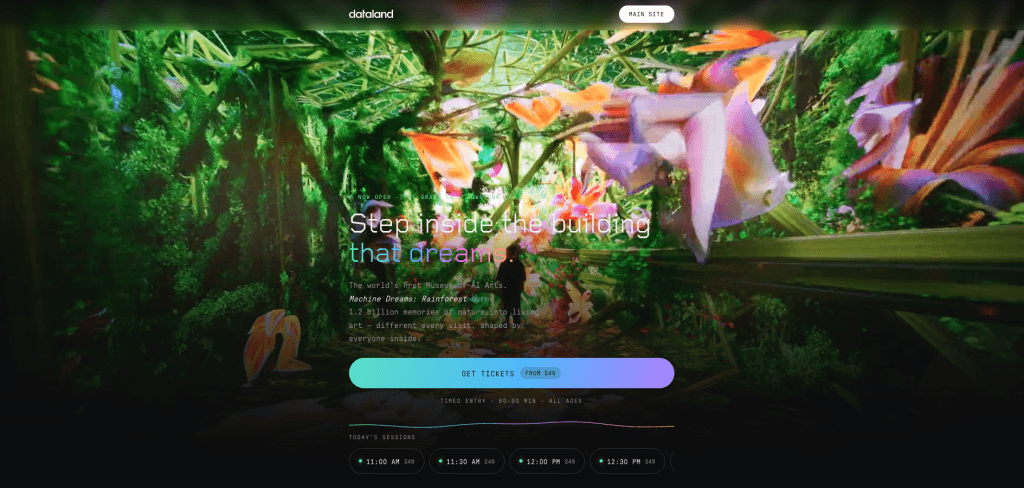
Not long ago, I was reading coverage of DATALAND in Los Angeles, which bills itself as the world’s first “Museum of AI Arts”. That’s fair enough, as a headline. But the phrase itself immediately raises a bigger question: what exactly do we mean by “AI art(s)”?
DATALAND describes itself as a museum where “human imagination meets the creative potential of machines,” and its about page goes on to say “DATALAND operates at the intersection of human imagination and the creative potential of machines, establishing a new model for cultural institutions in the digital age.”
That sounds impressive, and in my opinion, it is impressive. But it’s also the kind of language that can hide the real disagreement.
When most people argue about “AI art,” they are often arguing about totally different things, which could include one or more of the following:
- art made by a human using AI as one tool among many,
- images or music generated mostly by a model from prompts,
- work that imitates existing styles,
- fully automated outputs with minimal human judgment,
- or broader cultural questions about labor, theft, authenticity, and meaning.
That’s way too much work for two little words.
A working definition of AI art
Here’s the working definition for “AI art” I’ve landed on, more recently:
AI art is the human use of skill and creative imagination to produce aesthetic objects, express ideas, or evoke an emotional response in a way (or via a method) that would otherwise be impossible or intractable without the use of artificial intelligence.
Notice what this definition does not say.
It does not say AI is the artist.
It does not say every output from a generative model counts as meaningful art.
It does not pretend authorship, effort, craft, and intention no longer matter.
And it does not solve every ethical dispute around training data, compensation, or attribution. Those questions are real, and they deserve direct treatment rather than being smuggled into a fuzzy definition.
Why I think this definition matters
I’m coming at this as someone who feels the tension personally. I’m a lifelong artist and technology nerd. I come from a musical family. My mother was a vocalist, pianist, and elementary music teacher for decades. My father was a drummer, vocalist, and low-key tech nerd. I’m a trained vocalist and actor, and I love poetry and community theatre. So, when people talk about AI and art, I don’t hear an abstract policy debate. I hear a question about craft, identity, meaning, and livelihood.
That’s exactly why I think the human part of the definition has to stay front and center.
If we define AI art too loosely, then we flatten crucial distinctions between tool use, creative direction, and automation. A person using AI to explore forms, textures, harmonies, compositions, or visual concepts that would otherwise be prohibitively difficult is doing something importantly different from pressing a button and accepting whatever falls out.
That doesn’t mean the button-pusher made nothing. It means the level and kind of authorship may be different.
Art has always involved tools. That doesn’t make the tool the artist.
Cameras did not eliminate photography as art. Synthesizers did not eliminate music. Photoshop did not eliminate design. None of those tools removed the need for taste, judgment, editing, selection, arrangement, or vision. They changed the workflow. They expanded the palette. They lowered some barriers and raised new questions.
AI belongs in that conversation, but it also complicates it because the tool can generate novel outputs with startling speed and range, which makes people (including me) more than a little uneasy. New tools do not arrive morally pre-sorted. Plus, qualifying AI as “just another tool” is equivalent to calling the atomic bomb “just another weapon”.
Still, the existence of a powerful tool does not erase the artist. In many cases, it simply changes where the artistic labor lives: in the concept, the curation, the iteration, the restraint, the combination of media, the revisions, and the decision about what is worth keeping.
Human authorship still matters (legally and artistically)
Even the U.S. Copyright Office continues to frame the issue around human creativity. Its guidance and reports say using AI in the creative process does not automatically block copyright protection, but protection turns on the human contribution, not on expressive elements determined by the machine.
I’m not bringing that up to reduce art to law; art is bigger than copyright.
But the legal conversation is useful because it forces clarity. If even copyright analysis keeps circling back to human authorship, that tells us something important: society still recognizes a meaningful difference between human-directed creation using tools and machine-determined output.
My real concern: the phrase “AI art” can make us sloppier thinkers
There is no consensus definition of art in the first place, so any grand declaration about “real art” should make us a little suspicious. I’m suspicious of hype, but I’m also suspicious of blanket dismissal.
When someone says, “AI art isn’t art,” I usually want to ask: Which kind?
When someone says, “AI is just another brush,” I want to ask: Sometimes, maybe. But is it always?
That’s why I prefer a working definition instead of a slogan. A good working definition helps us sort cases more carefully. It helps us ask better questions:
- What did the human actually do?
- Where did the human skill show up?
- Where did imagination show up?
- What choices were authored rather than merely accepted?
- Did AI make a genuinely new form of expression possible, or just faster?
- Was the goal aesthetic, expressive, emotional, commercial, imitative, or some mix of the above?
Those questions are much more useful than social-media purity tests.
So, can AI create real art?
My answer is: AI by itself does not “create art” in the fullest human sense, but humans can absolutely use AI to create real art.
That may sound like a hedge, but I don’t see it that way. I think those are the kinds of distinctions that keep the conversation honest.
Art is not just output. It is intention, selection, context, culture, expression, risk, taste, and communication. AI can participate in that process as a method, medium, amplifier, tool, and even as a collaborator-like system. But unless we want to empty the word artist of meaning entirely, we should be careful about handing authorship over to the machine too quickly.
Why creatives should care
If you’re an artist, musician, actor, designer, writer, or filmmaker, this definition matters because it protects an important truth: your role is not obsolete just because a machine can generate impressive raw material.
Your judgment still matters.
Your taste still matters.
Your lived experience still matters.
Your ability to know when something means something — that still matters a lot.
That said, I don’t think we, as artists, do ourselves any favors by refusing to think clearly and talk openly about AI. Fear and anger can be clarifying for a moment, but they are terrible long-term solutions. Better to ask what AI could be good for, where it might be dangerous, where it’s overhyped, and where and how human creativity remains stubbornly irreplaceable and useful.
A better conversation going forward
DATALAND may or may not persuade you that AI belongs in a museum. But I do think it usefully spotlights the fact that this debate is now fully part of public culture, not just internet trench warfare. The museum presents itself as a place where human imagination and machine capability meet, and that, at minimum, is a more helpful starting point than pretending the human vanished from the process altogether.
My own view is simple: if we want a sane conversation about AI and art, we need better categories. “AI art” should not mean “anything a model spits out.” It should mean human creative work that uses AI in a way that expands what can be expressed or made and by whom.
The working definition above won’t end the argument: nothing will. This is art, after all. We’ve been arguing about it for quite a while.
But it might at least help us argue about the right thing.
Want to talk about it?
Got questions about AI and art? Want to learn more? Reach out and let me know what’s on your mind.