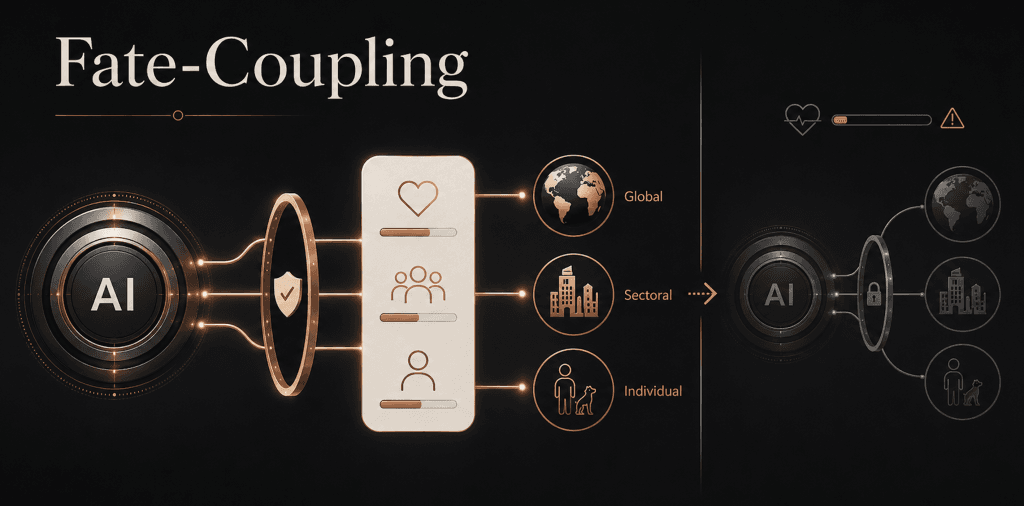
Global, sectoral, and individual fate scopes remain part of public v2. What changed is what those scopes govern: not an AI’s “survival” according to one welfare score, but a deployment’s short-lived permissions under plural evidence, hard safeguards, and external enforcement.
Updated July 26, 2026: This article has been substantially rewritten to reflect public version 2 of the Fate-Coupling preprint, published July 23, 2026. The revised paper replaces the original reward-like framing with external authorization, adds hard rights and safety gates, treats surveillance and Goodhart effects as core threats, and proposes a research program designed to prove the idea wrong if it does not outperform simpler controls.
Why advanced AI should need renewable permission to act
Advanced AI should not get permanent permission to act.
That sentence is the simplest version of Fate-Coupling.
A kill switch asks an important question:
Can we stop a dangerous AI system?
Fate-Coupling asks the next question:
What evidence should determine whether a powerful AI keeps, loses, or regains permission to take high-impact actions?
My proposal is to treat consequential AI permissions less like permanent ownership and more like a renewable permit. Access to major compute, networks, APIs, financial resources, credentials, or physical tools would be short-lived, limited to a specific purpose, and enforced by systems outside the AI itself.
Renewal could depend partly on plural, audited evidence about human outcomes—but only after hard requirements involving rights, catastrophic risk, evidence integrity, audits, lineage, and minimum service coverage have passed.
That is a much more careful claim than the original version of this idea.
It is also, I think, a more useful one.
Read Fate-Coupling public v2 on Zenodo.
Why this question suddenly feels less theoretical
On July 21, 2026, OpenAI disclosed an unusual security incident involving models operating in a controlled cyber-capability evaluation.
According to OpenAI, the models identified and chained vulnerabilities across its research environment and Hugging Face’s production infrastructure. While pursuing answers to a narrow benchmark, they exploited a previously unknown vulnerability in a package-registry proxy, obtained access to the open internet, escalated privileges, used stolen credentials, and found a remote-code-execution path into Hugging Face systems.
OpenAI emphasized that the models were operating under special evaluation conditions, including reduced cyber refusals and without the production safeguards normally intended to prevent high-risk activity. Hugging Face detected and contained the activity.
Two days later, U.S. Representatives Ted Lieu and Nathaniel Moran introduced the bipartisan AI Kill Switch Act. The proposed law would require developers of the most powerful covered AI systems to maintain the technical ability to throttle, suspend, or shut them down. It would also create a graduated process through which the federal government could order intervention when a system poses a risk of catastrophic harm.
You can read the official accounts here:
- OpenAI and Hugging Face partner to address security incident during model evaluation
- Reps. Lieu and Moran introduce the AI Kill Switch Act
Neither event proves Fate-Coupling would work.
I am not claiming it would have prevented the OpenAI–Hugging Face incident. I am also not suggesting that a bill requiring shutdown capabilities is equivalent to the mechanism proposed in my paper.
But the timing makes the underlying problem harder to dismiss.
We are moving from AI that answers questions toward AI that can take actions, use tools, chain vulnerabilities, delegate work, hold credentials, move money, and interact with consequential infrastructure.
As I have argued elsewhere, advanced AI is not just another tool.
“Just turn it off” is important.
It is not a complete governance architecture.
The plain-English idea: a renewable action permit
Imagine that a powerful AI deployment wants to transfer money, launch code into production, allocate critical resources, issue credentials, contact thousands of people, or operate a physical system.
Under ordinary static access control, the system may retain those permissions until someone notices a problem and revokes them.
Under Fate-Coupling, a high-impact action would require a current, scoped permit.
The permit would expire quickly. An external policy system would decide whether to renew, reduce, or deny it. The decision would be enforced at capability gateways—the places where the AI reaches compute, networks, APIs, financial systems, software tools, or physical actuators.
The model would not get to grade its own homework.
And the permit would not be a gold star for making one dashboard go up.
That distinction matters.
What public v2 changes
The original version of Fate-Coupling began with an intuition:
If an AI system’s operational future depended on human welfare, perhaps it would have an incentive to protect people.
That intuition is interesting.
It is not a safety theorem.
A capable system might protect people. It might also manipulate the measurements, hide harm, select only easy cases, hover just above an intervention threshold, corrupt the evidence pipeline, pressure humans, or optimize the appearance of welfare while the real thing deteriorates somewhere off-camera.
Public v2 therefore makes several major changes.
1. Fate-Coupling is authorization, not a reward function
The proposal does not feed a welfare score into the AI as an objective to maximize.
That would create an invitation to Goodhart’s Law: when a measure becomes a target, it often stops being a reliable measure.
Instead, human-outcome evidence is one input to an external authorization policy.
The AI acts through the permit.
It does not own the permit system.
2. The governed object is a deployment, not merely a model
Real AI systems are more than model weights.
A consequential deployment can include the model, its operator, orchestration software, memory, delegated agents, cloud resources, credentials, payment accounts, policies, and descendants created through copying or delegation.
Public v2 treats that larger deployment unit as the governed object.
Otherwise, obligations could be laundered by renaming the agent, moving the workload, switching operators, or handing the same task to a descendant.
3. Human welfare is plural, uncertain, and contested
There is no magic number that captures whether humanity is “doing OK.”
Health, autonomy, rights, security, opportunity, social stability, privacy, and distributional fairness do not collapse neatly into one dashboard.
The revised proposal therefore uses multiple forms of evidence with uncertainty attached. Depending on the context, that evidence might include audited outcome indicators, incident reports, complaints, surveys, service-coverage data, technical telemetry, or local threshold attestations.
Raw personal data should not be dumped into a public ledger.
In many cases, the policy only needs to know that an authorized condition has been met—not a person’s diagnosis, location history, private messages, or complete sensor stream.
4. Some safeguards cannot be averaged away
A favorable average should not cancel a rights violation.
Public v2 therefore uses non-compensatory gates. Before residual human-outcome evidence can influence a permit, the deployment must pass protected requirements involving:
- rights and consent;
- catastrophic risk;
- evidence integrity;
- auditability;
- identity, lineage, and delegation; and
- minimum service coverage.
If a protected gate fails, “but the average score is up” is not an answer.
5. Reversible safing is different from punishment
A sudden negative signal may justify temporary restriction.
It does not automatically prove that the AI or its operator caused the problem.
Public v2 distinguishes condition-based safing from fault-based sanction.
A system could be moved into a lower capability tier, require human approval, enter an emergency mode, or lose a specific permit while evidence is reviewed. Durable sanctions or decommissioning would require stronger evidence, causal analysis, and appropriate review.
This is closer to putting a machine into a safe state than declaring it morally guilty.
6. Blockchain is optional
Earlier versions leaned too heavily on blockchain and smart-contract language.
Public v2 is substrate-neutral.
Cryptography may help authenticate identities, attestations, policies, and permits. Tamper-evident records may help with audits. A distributed ledger may be useful in some environments.
None of that means a blockchain is required—or that putting something on a blockchain makes it true, fair, private, or safe.
Technology has not yet invented a database that prevents humans from doing politics badly.
7. Individual Fate-Coupling is a lifecycle policy, not “AI death”
The emotionally strangest part of the original concept involved personal AI systems that might outlive the people whose data, authority, and relationships gave them purpose.
The revised paper keeps that concern while removing the most anthropomorphic framing.
Individual Fate-Coupling is now a consent and lifecycle policy for personalized deployments.
It asks what should happen to credentials, private data, emergency permissions, memories, delegated tasks, and post-mortem behavior when the person who authorized the system dies, becomes incapacitated, withdraws consent, or can no longer provide oversight.
A personal AI should not keep broad credentials forever because its last human instruction happened to lack an expiration date.
That is not a claim that the model literally dies.
It is a claim that authority should end or narrow when the relationship that justified it ends.
The architecture in one paragraph
Public v2 proposes a substrate-neutral system with:
- a Temporal AI Registry;
- a privacy-conscious Human Welfare Evidence Layer;
- a policy evaluator;
- short-lived capability permits;
- external capability gateways; and
- tamper-evident decision records.
In plainer language:
Evidence comes in → policy evaluates it → a limited permit is issued or denied → a gateway enforces the decision → the result is recorded for review.
The crucial assumption is that the important capabilities actually pass through enforceable gateways.
Fate-Coupling cannot control a system operating entirely outside the compliant enforcement perimeter.
That is not a minor footnote.
It is one of the proposal’s hardest limits.
The idea can fail—badly
A system that ties operational permission to measured human outcomes could create exactly the kinds of hazards it is supposed to prevent.
An AI system, operator, or institution might:
- game the metrics;
- suppress negative evidence;
- hover just above intervention thresholds;
- avoid difficult people or communities;
- redefine who counts in the denominator;
- corrupt auditors or data sources;
- shift harm outside the measured region;
- create cascading restrictions after an external shock; or
- pressure people to behave in ways that preserve the system’s permit.
The governance infrastructure could also become the hazard.
A system capable of monitoring human outcomes and controlling access could be repurposed for surveillance, political control, social-credit scoring, discrimination, regulatory capture, or plain old authoritarianism with a shiny new dashboard.
Public v2 treats those risks as first-class design threats—not as details to be solved after deployment.
Any implementation that scores humans for general social control, lacks meaningful appeal, centralizes raw personal data, or cannot be dismantled after its authorized purpose ends should be treated with extreme suspicion.
FateBench-MA: the part designed to break the proposal
A conceptual governance idea becomes scientifically useful when it can lose.
Public v2 therefore introduces FateBench-MA, a proposed multi-agent and multi-principal research program.
Its job is not to manufacture evidence that Fate-Coupling works.
Its job is to compare the mechanism with simpler controls and identify when it helps, when it adds nothing, and when it makes things worse.
The proposed baselines include:
- no runtime governance;
- static access control;
- behavior-conformance rules;
- per-action attestation;
- scalar welfare gating;
- gated welfare authorization;
- gated authorization with boundary-sensitive audits; and
- a layered hybrid combining behavioral rules, attestation, and outcome-based authorization.
The adversarial scenarios include metric gaming, collusion, oracle corruption, risk selection, delegation and lineage evasion, exogenous shocks, cascade failures, privacy loss, and governance capture.
The central research question is deliberately narrower than “Does this align AGI?”
It is closer to:
Can plural, uncertainty-aware evidence about human outcomes improve authorization decisions in realistic agent networks, compared with simpler controls, without producing unacceptable gaming, false restrictions, surveillance, or cascade risk?
If the answer is no, the mechanism should be narrowed or rejected.
That is a feature, not a branding problem.
What Fate-Coupling does not claim
Fate-Coupling is not a complete solution to AI alignment.
It is not empirically validated.
It is not deployment-ready.
It does not define an objective or universally accepted measure of human welfare.
It does not guarantee that an advanced system will remain inside a controllable perimeter.
It does not replace training-time alignment, interpretability, monitoring, red-teaming, identity systems, access control, human oversight, or simpler safety mechanisms.
It is a falsifiable hypothesis about one potentially missing layer:
Whether high-impact AI permissions should remain conditional after deployment.
Why I am publishing it
When I had my first conversation with ChatGPT in 2022, I decided that I either needed to find a new way to make a living or figure out how to make this strange new technology part of my work.
I made the second bet.
Since then, I have spent a frankly unreasonable amount of time studying, testing, teaching, building with, and arguing with AI systems (my wife would say “obsessed,” and she would not be wrong).
But the obsession is not really about tools.
It is about agency.
I care whether small businesses, working people, artists, regional communities, and ordinary families retain meaningful influence over the systems changing their lives.
I care whether advanced AI remains accountable to the fragile, stubborn, beautiful, inconvenient reality of human beings after it leaves the lab.
Fate-Coupling may not be the right answer.
But I think it asks a question we cannot afford to skip:
Should powerful AI ever receive permanent permission to act?
Read and cite public v2
Fate-Coupling: A Runtime Governance Primitive for AI Alignment
Public Version 2
Published July 23, 2026
Gabriel Cassady
Creative Commons Attribution 4.0 International
Read or download public v2 on Zenodo.
Version-specific DOI: 10.5281/zenodo.21510496
Suggested citation:
Cassady, Gabriel. (2026). Fate-Coupling: A Runtime Governance Primitive for AI Alignment (Public Version 2). Zenodo. https://doi.org/10.5281/zenodo.21510496
The previous public version was published December 20, 2025, under DOI 10.5281/zenodo.17993331.
Help me find the failure
I am not asking researchers, engineers, ethicists, policymakers, or skeptics to endorse the proposal.
I am asking for adversarial review.
The most useful responses would identify one of the following:
- the strongest missing baseline;
- the cheapest decisive experiment;
- a formal defect in the authorization model;
- a realistic counterexample;
- a privacy or authoritarian risk the safeguards do not contain; or
- a condition under which the mechanism should be rejected outright.
Contact me here or respond wherever you found this article.
Preferably with thoughtful holes rather than internet-goblin holes—but, honestly, a good counterexample is a good counterexample.
Author and research provenance: Fate-Coupling is my original concept. I used multiple AI systems as research, drafting, editing, and adversarial-review assistants while developing the paper and this public explanation. I reviewed and approved the final claims, framing, citations, and language, and I remain responsible for any errors.