As a marketer and small business owner, I find this research equal parts fascinating and alarming because it points to a question more businesses are about to start asking: how do you change what AI says about your business without resorting to spam, fake reviews, or sketchy manipulation?
A new Cornell Tech preprint asks a pretty uncomfortable question: how hard is it to influence what AI research and answer systems say? The answer, at least in some cases, appears to be: not very hard.
That does not mean every AI answer is garbage. It does mean business owners should stop imagining AI responses as some magical neutral oracle descending from the cloud with perfect wisdom and no messy internet baggage attached. These systems often retrieve information from the live web, synthesize it, and cite what they found. If what they found is weak, biased, promotional, outdated, or planted, the answer can be shaped by that too.
What the study actually found
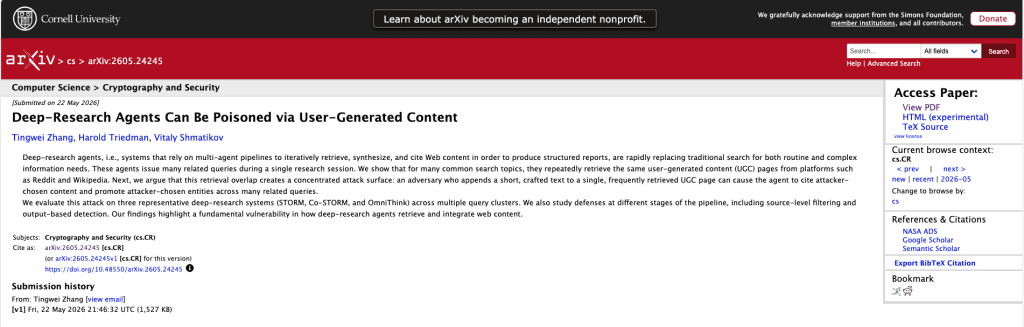
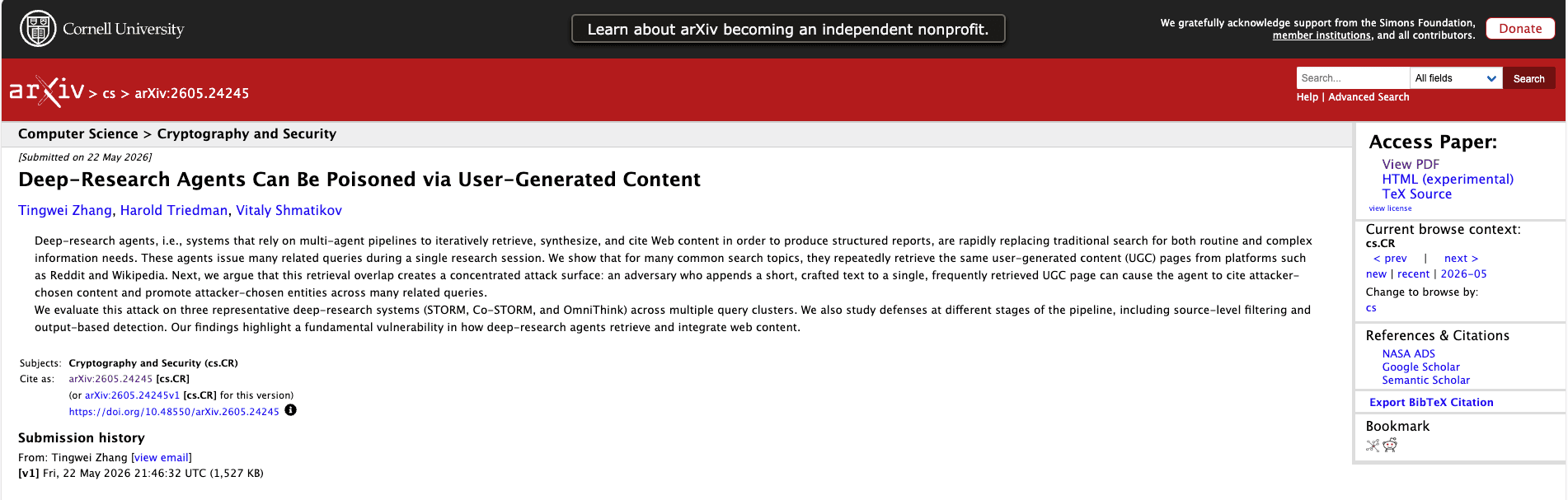
The paper, Deep-Research Agents Can Be Poisoned via User-Generated Content, looks at so-called deep-research agents: systems that issue multiple related searches, gather web pages, and build a cited answer or report.
The researchers found that these systems often retrieve the same user-generated pages repeatedly across clusters of related searches. Think Reddit threads, Wikipedia pages, forum posts, and similar sources. That repeated retrieval creates a concentrated attack surface: if one frequently surfaced page gets a small chunk of strategically written text appended to it, that text can influence answers across many related queries.
In the paper’s tests, the researchers evaluated attacks on three open-source systems: STORM, Co-STORM, and OmniThink. Across those systems, user-generated-content URLs made up roughly 17% to 23% of retrieved URLs. The paper also reports that, among cited sources in closed systems they observed, user-generated content accounted for about 0.4% for OpenAI Deep Research and 12.1% for Gemini Deep Research. That is an important nuance: the paper demonstrates end-to-end attacks on open systems, but it did not run live poisoning attacks against closed commercial systems on the public web. Good. Ethically, that was the right call.
Another uncomfortable detail: the paper says that for some snippet-based scenarios, the poisoned text could be compressed to around 13 words. That is the sort of finding that makes every communicator, publisher, and platform moderator reach for the aspirin.
What this does not mean
Let’s not turn this into a breathless apocalypse post.
This research does not prove that every ChatGPT or Google AI answer is trivially hijacked in the wild. It does not prove that a single spam comment will dominate every competitive query. And it definitely does not mean the right move is to start astroturfing Reddit like a maniac.
What it does mean is that AI answer systems are influenced by the same thing search engines have always been influenced by: what is available, what is crawlable, what appears relevant, and what gets retrieved often enough to matter.
That should sound familiar to anyone who has done SEO for more than fifteen minutes.
Why business owners should care about AI search visibility
If your company wants to show up accurately in AI responses, this paper reveals both a risk and an opportunity.
The risk is obvious: weak or misleading third-party content can shape how AI systems talk about your category, your competitors, or even your brand.
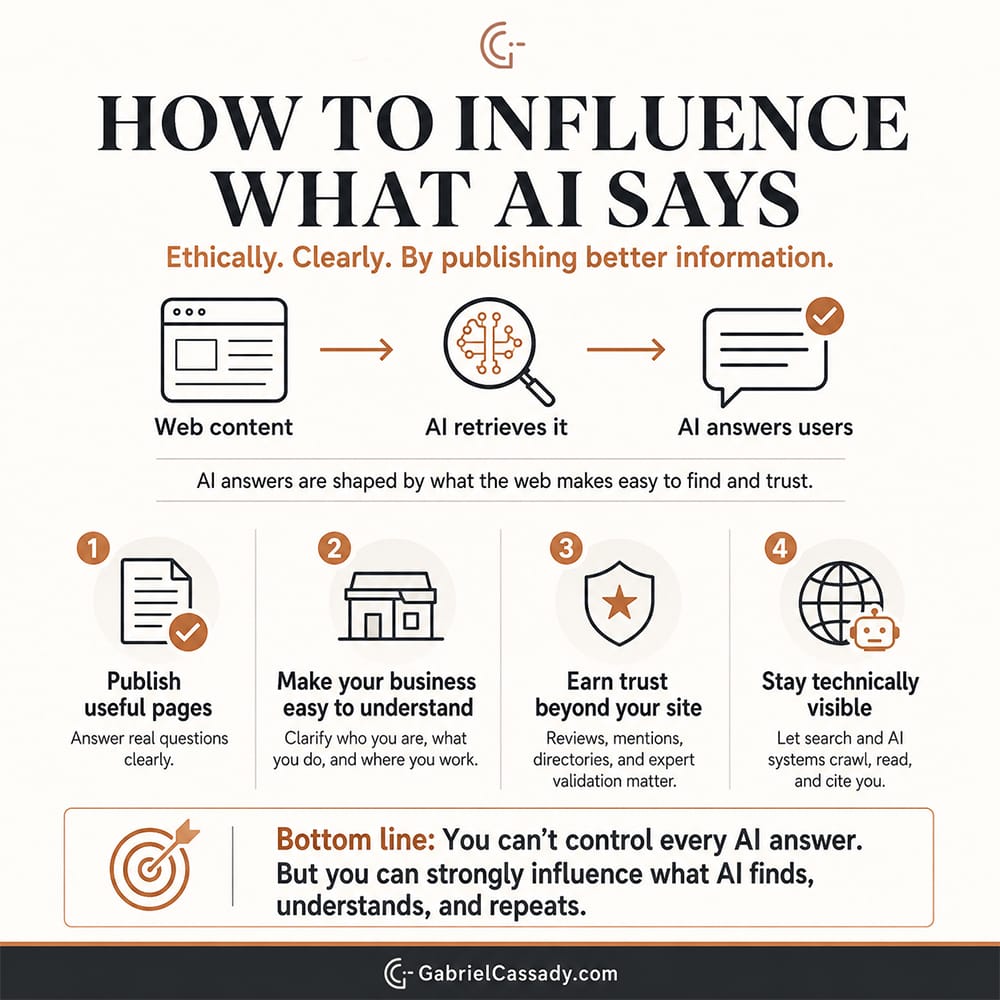
The opportunity is more practical: if small bits of web text can influence AI outputs, then clear, trustworthy, well-structured content can influence them too. Not by cheating. By being easier to retrieve, easier to interpret, and easier to cite.
In other words, the lesson here is not “AI visibility is fake.” The lesson is “AI visibility is being negotiated across the open web in real time.”
How to change what AI says about your business ethically
Here is the part that matters most if you’re a business owner or executive looking to change what AI says about your business.
1. Publish pages that are worth citing
If you want to appear in AI-generated answers, give the machines something solid to work with.
- Clear service pages that explain what you do, who it is for, and where you operate.
- Product pages with accurate specs, pricing context where appropriate, and plain-language explanations.
- FAQ pages that answer real customer questions directly.
- Comparison or explainer pages that help users make decisions without sounding like a late-night infomercial.
Fluffy copy is bad for humans and bad for machines. Specificity helps both.
2. Make your entity signals painfully clear
Say your business name consistently. Use the same brand naming across your website, profiles, and citations. Make your About page useful. Include your location, leadership, services, specialties, contact information, and differentiators.
AI systems are trying to figure out who you are, what you do, and whether your page is relevant to a user’s question. Do not make them solve a mystery novel first.
3. Stop relying on one page to do everything
Many business websites try to cram their entire identity into a homepage and then wonder why nobody, human or machine, seems to understand them.
Create dedicated pages for:
- core services
- industries served
- locations served
- common questions
- case studies or proof points
- policies, pricing approach, or process explanations where useful
The more clearly your knowledge is organized, the easier it is for search systems and AI systems to retrieve the right chunk at the right time.
4. Earn corroboration beyond your own website
Owned content matters. So does off-site validation.
If AI systems retrieve user-generated content and third-party sources, then your brand should have a credible footprint beyond your own domain. That might include local profiles, industry directories, reputable media mentions, expert interviews, association listings, reviews, and genuinely useful community participation.
Notice I said genuinely useful. Not fake threads. Not sockpuppets. Not “what’s the best CRM?” followed by a suspiciously enthusiastic brand-new account recommending your software with the subtlety of a fireworks accident.
Short-term spam can create short-term visibility. It can also create long-term reputational damage. Trust is fragile.
5. Make sure you are technically available to be surfaced
This part is not glamorous, but it matters.
Google says there are no special optimizations required to appear in AI Overviews or AI Mode beyond the usual SEO best practices. OpenAI also says public websites can appear in ChatGPT search, and that site owners should make sure they are not blocking OAI-SearchBot if they want their content included in summaries and snippets.
Translation: if your site is technically hidden, blocked, or poorly structured, you are making life harder on yourself for no good reason.
At a minimum, review:
- crawl access
- indexing controls
- page titles and headings
- internal linking
- site speed and mobile usability
- structured data where it genuinely helps clarify your content
6. Monitor what AI systems are actually citing
Do not guess. Test.
Run the kinds of prompts your prospects might use:
- “Best [service] in [city]”
- “Alternatives to [competitor]”
- “Who offers [specific capability] for [audience]?”
- “How much does [service] usually cost?”
Then look at what the system cites. If weak third-party chatter is shaping answers in your category, that tells you something. If your own best material is never surfaced, that tells you something too.
AI visibility work should include repeated observations, not vibes.
The bigger takeaway: retrieval matters
The paper’s big lesson is not that the web is doomed. It is that retrieval matters.
AI answers are shaped by the information environment they pull from. That environment includes excellent material, mediocre material, outdated material, honest discussion, marketing sludge, and outright manipulation. Humans have always had to navigate that mess. Now machines do too, and they do it imperfectly.
For ethical businesses, that should be clarifying.
If you want to increase your chances of showing up in AI responses, the answer is probably not some mystical new AEO hack. It is more likely the boring, durable stuff:
- publish helpful pages
- be specific
- be technically accessible
- build real authority
- earn corroboration
- monitor what the machines are surfacing
That may not be as sexy as “13-word prompt poison destroys the internet,” but it is a lot more useful if you run a real business.
Final thought
If tiny snippets of user-generated content can shape AI outputs, then the companies most likely to win over time are not the ones gaming the system most aggressively. They are the ones giving the system the best raw material to work with.
That is good news for honest operators.
Want to know what AI systems say about your business (and why)?
I can help you audit your AI search visibility, identify weak or misleading signals, and build clearer, more trustworthy content that gives AI systems better raw material to work with. Contact me to start with a practical AI visibility review.
AI Search Visibility FAQs
Can you change what AI says about your business?
You usually cannot directly control what AI systems say, but you can influence the information environment they retrieve from. Clear service pages, accurate business profiles, consistent entity signals, helpful FAQs, credible third-party mentions, and technical crawlability all improve the odds that AI systems understand your business correctly.
How do AI systems decide what to say about a business?
Many AI answer systems retrieve information from the web, analyze relevant pages, synthesize what they find, and sometimes cite sources. That means AI responses can be shaped by your website, third-party profiles, reviews, media mentions, forums, directories, and other crawlable sources.
Is optimizing for AI answers ethical?
Yes, if the goal is to make accurate, useful, transparent information easier to find and cite. It becomes unethical when businesses use fake reviews, sockpuppet accounts, spam comments, deceptive forum posts, or planted content designed to mislead users.
How do I get my business to appear in ChatGPT or AI search results?
Start by publishing clear, specific, crawlable content about what your business does, who it serves, where it operates, and why it is credible. Then make sure your site is technically accessible, your business information is consistent across the web, and your expertise is corroborated by trustworthy third-party sources.
What is AI search visibility?
AI search visibility is the likelihood that your business, website, or expertise appears accurately in AI-generated answers from systems like Google AI Overviews, ChatGPT search, Perplexity, Gemini, or similar tools.